Weekly Pool Service
A set service day for skimming, brushing, baskets, filter checks, testing, and balancing.
Learn more →Palm Beach County, FL
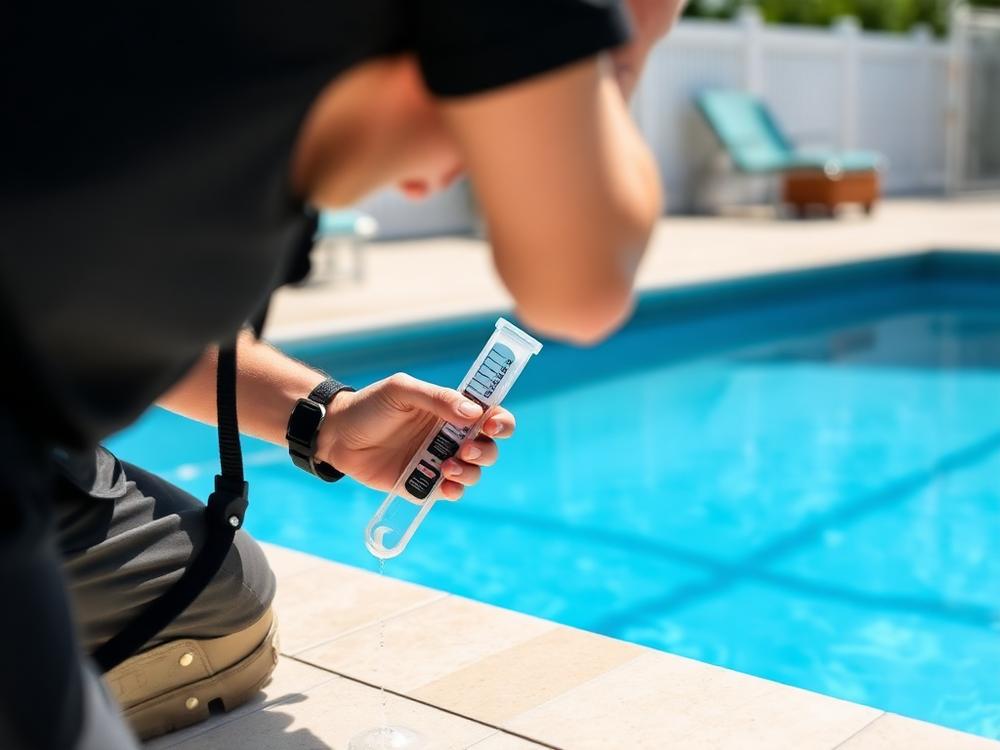
Balanced water is what protects everything else — the finish, the tile, the heater, and the people swimming in it. Most water problems homeowners describe as random are actually one reading out of range pulling the others with it. We test the full panel rather than a strip's worth of it: free chlorine, pH, total alkalinity, cyanuric acid, calcium hardness, and salt where a chlorinator is installed. Then we correct in the right order, because adjusting pH before alkalinity simply undoes itself. You get the numbers in writing along with what changed and why, so the water stops feeling like guesswork and starts behaving predictably between visits.
Do You Need This?
What's Included
Our Process
Every reading is taken at the same point in the pool at a consistent depth, so week-over-week comparisons actually mean something.
Alkalinity first, then pH, then sanitizer and stabilizer. Correcting out of order is the most common reason DIY balancing never sticks.
Adjustments need run time to distribute. We set or confirm pump schedules so the correction reaches the whole body of water.
Readings are logged over time. A stabilizer level drifting down every month tells you something a single test never will.
Why It Matters
Local Conditions
Two local realities dominate pool chemistry here. First, intense UV destroys unprotected chlorine within hours, which makes stabilizer management the difference between a pool that holds and one that does not — but too much stabilizer locks sanitizer out entirely, and heavy rain constantly shifts that balance. Second, local fill water tends to run hard and alkaline, so calcium and scale build on tile and inside heat exchangers. Summer rain dilutes and drops pH quickly, while long dry spells with heavy evaporation concentrate everything back up.
Questions
Weekly during Palm Beach County's warm months at minimum. Heavy rain, a pool party, or a heater running for several days can all shift readings enough to justify an extra test.
That smell comes from chloramines — chlorine that has already bound to contaminants and stopped sanitizing. It usually means free chlorine is low relative to demand, not that there is too much chlorine.
It is the stabilizer that shields chlorine from sunlight. In Florida sun, too little and your chlorine burns off in hours; too much and the chlorine you add is effectively locked out. Managing that window is a big part of the job.
Yes. A salt chlorinator produces chlorine but does nothing for pH, alkalinity, stabilizer, or hardness — and salt cells drift in output as they age, so the water still needs regular verification.
Coverage
A set service day for skimming, brushing, baskets, filter checks, testing, and balancing.
Learn more →Cartridge, DE, and sand filter cleaning to restore flow and fix stubborn cloudiness.
Learn more →Algae removal, filtration correction, and a chemistry rebuild for pools that have turned.
Learn more →Debris removal, vacuuming, filter checks and chemistry rebalancing after heavy rain or a wind event.
Learn more →Salt-level testing, salt-compatible balancing, cell inspection and cleaning, and circulation checks on a regular schedule.
Learn more →Next Step
Send the details and we will follow up to arrange a look at the property and give you a personalized price.